For nearly a decade now, Square Enix has invested heavily into what the company calls “HD-2D” projects. Spanning titles like Octopath Traveler, Triangle Strategy, and more recently, The Adventures of Elliot: The Millennium Tales, these are games inspired by classic titles, wrapped in a beautiful pixel aesthetic that’s been polished up for a modern audience.
You could say that the advent of these HD-2D games began with Octopath Traveler, but truly, I think it’d be more accurate to say that their roots stemmed from 2012’s Bravely Default, an unassuming JRPG that was released for the 3DS. All of these games have been led by what’s colloquially known as Team Asano, a team of developers within Square Enix headed up by Tomoya Asano, which specializes largely in turn-based RPGs. I had the opportunity to chat with Naofumi Matsushita, the game producer for The Adventures of Elliot: The Millennium Tales, where we chatted about the difficulties of making a new adventure game in the HD-2D style, the defining element of a Team Asano game, and more.
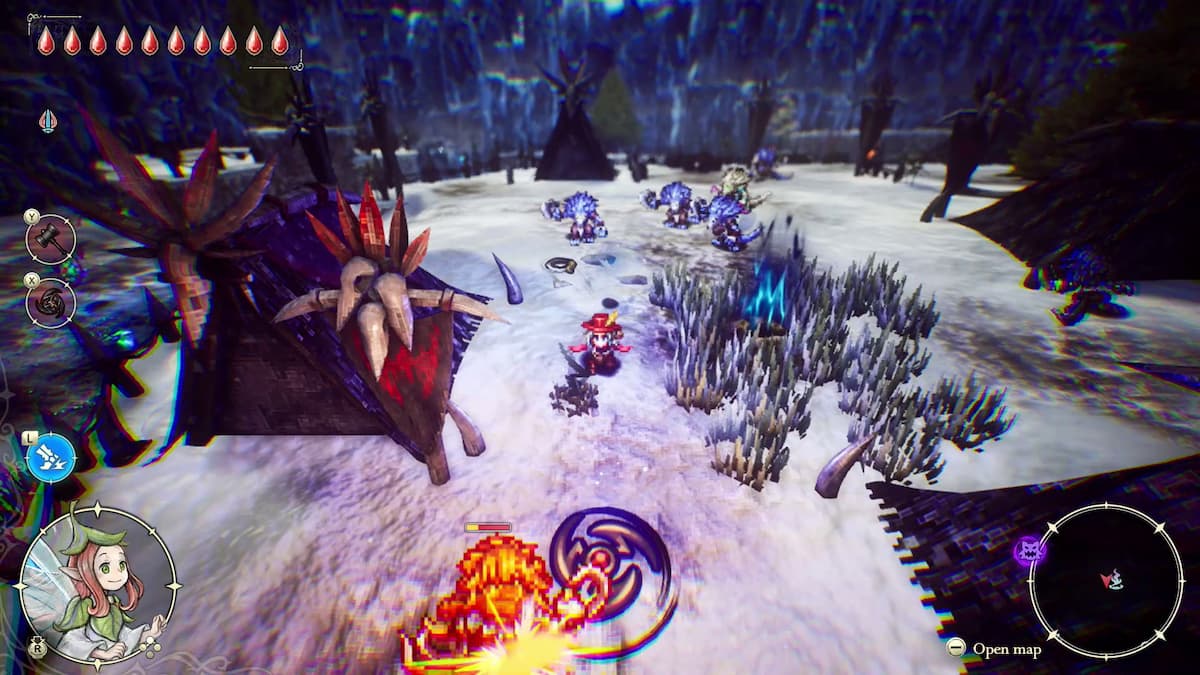
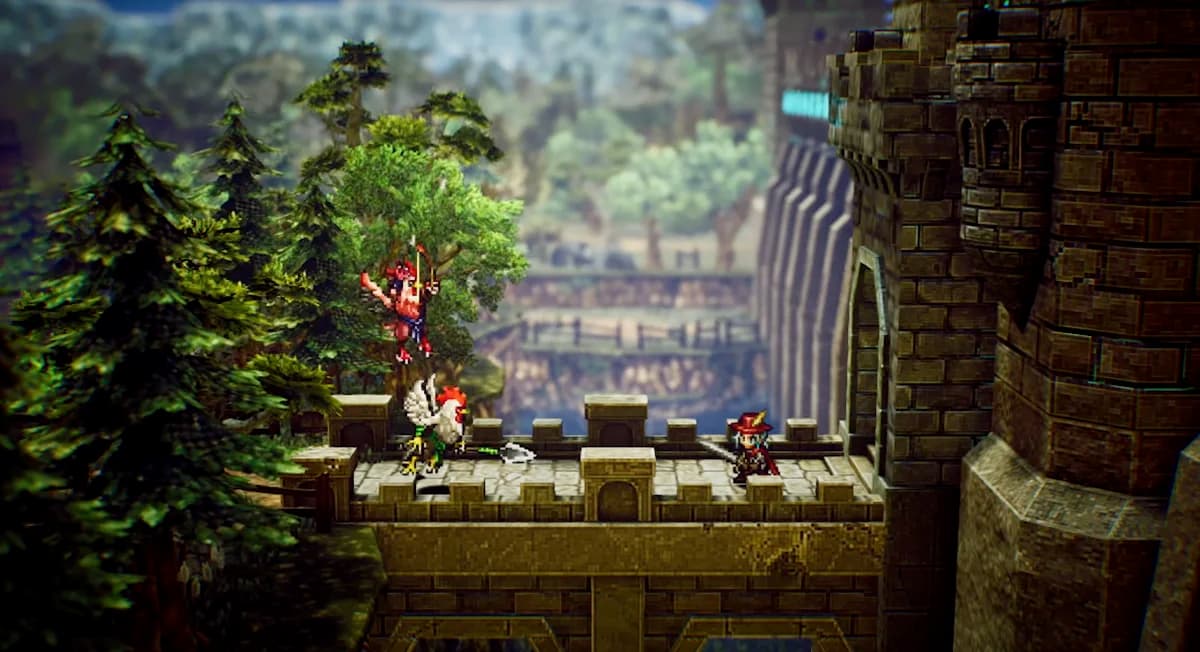
If you’ve seen any of Square Enix’s HD-2D games, you’ll know that it’s not just the stellar pixel art that sells the game; it’s the 3D backgrounds and environments too, which add depth to the experience. “One of the main challenges was finding a way to blend this strength with 2D action gameplay,” Matsushita tells me, “In pixel-based 2D action games, the screen can easily become dominated by the ground plane of the map, making it difficult for players to feel any sense of three-dimensional depth and causing the visuals to feel somewhat flat.”
For Elliot, Matsushita says the team adopted a “drumroll” approach, which means “curving the map into the background so that distant terrain becomes visible.” The idea was to make the visible range in the game as large as possible, making the world feel not just large, but also layered and dynamic.
The team also encountered difficulties when it came to designing the HUD layout in The Adventures of Elliot. Originally, the team had wanted to reduce the number of onscreen elements to “maintain visibility and avoid cluttering” but this soon became a challenge as features like local co-op and conversations with support characters meant that there was a lot of crucial information that needed to be displayed. To get around this, Matsushita points out that the final build of the game now include settings that allow the destination marker and button prompts to disappear after a set period of time. Matsushita goes on to say that he encourages players to customize these settings to suit their preferences, and mentions that this ended up being the biggest compromise the team had to make in order to keep the game readable and fun in real-time combat.
That being said, Matsushita reaffirmed that while there were some areas in the game that required repeated adjustments, he believes that the team has “implemented everything [they] originally envisioned for the game and fine-tuned it to a level [they’re] happy with.”
Interestingly enough, when I asked about the ending of The Adventures of Elliot and if anything major had changed after early testing and feedback, Matsushita mentioned that an earlier build of the game had made it so that getting all of the endings would be a much more challenging endeavor.
“One area put a great deal of effort into refining midway through development was the structure of the story’s final act, based on feedback from our internal playtests,” Matsushita says. “In the original design, discovering all of the endings was intended to be much more challenging. However, we ultimately felt that this approach wouldn’t fully convey the game’s strengths. While we still wanted players to discover the trigger that sets the story in motion on their own, we revised the game to provide clearer guidance so that, once the story begins to unfold, they can move forward without hesitation. The narrative is structured to become increasingly rewarding as you progress toward its conclusion.”
It’s worth noting that this is a marked departure from how things were back during the Octopath Traveler days, which notoriously had a secret post-game dungeon that was extremely hard to find if you weren’t a completionist or didn’t know what to look for. Things changed dramatically with the release of Octopath Traveler II, which came with more guidance, and having played through The Adventures of Elliot, I can confidently say that this is the most accessible Team Asano game so far when it comes to unlocking the secrets that have been hidden away.
On the topic of Team Asano games, I asked Matsushita what he would describe as a “defining feature” of a game made by Team Asano, and how The Adventures of Elliot: The Millennium Tales still retained that element despite being a completely different genre from what came before. Matsushita prefaced his answer by saying that this was strictly his personal opinion, but his belief is that “it’s important to build a strong foundation through the game’s world, characters, and narrative, while also recognizing that every player has their own preferred way of enjoying the gameplay.” He tells me that the team’s slogan is “exceeding fans’ expectations” and that the team “places great importance on setting aside sufficient time for fine-tuning during the final stages of development, allowing [us] to polish the game to a level [they’re] truly satisfied with.”
Of course, I couldn’t end off without at least asking Matsushita if he had a favorite character from all of the games he’s worked on so far. “As a developer, I’m always a little hesitant to name my favorites because I worry it might come across as if I’m forcing my preferences on others, so I usually avoid talking about them too much,” Matsuhita hesitates, “But if I had to choose, it’d be Orion from Various Daylife, Martha from Bravely Default II, Oersted from Live A Live, and Ringabel from Bravely Default.”
Matsushita appears to have a strong affinity with our red fedora-donning protagonist from The Adventures of Elliot though, as he also states: “If I had to pick just one, it would have to be Elliot. As the first original character I was personally responsible for, he naturally holds a special place in my heart, and I became deeply invested in bringing him to life. During the most difficult stages of development, I felt that his never-give-up spirit was what kept me going. I’d be happy if everyone who plays this game is inspired by him in the same way.”
The Adventures of Elliot: The Millennium Tales is now available on PC and consoles.