Developed by Housemarque, best known for making PlayStation-exclusive titles like Returnal and Resogun, Saros is a third-person roguelike shooter that embodies all of the studio’s greatest strengths. Fast-paced action, unforgiving bosses, and a game flow that lives and dies by how well you’re able to adapt and survive.
I was already thoroughly impressed with the way Saros played and felt when I previewed it last month, though I still felt some trepidation jumping into the retail build. I’m not particularly good at challenging video games; all of my ‘success’ in FromSoft’s Souls games stemmed from hours upon hours of tumultuous anger, frustration, and repeatedly banging my head against the same wall until something miraculously clicked, allowing me to progress. Most pertinently, I had a deadline to meet with Saros. Would I really be able to put myself through that frustration again and also conquer this game in time for the review?
Well, if you’re reading this, the answer is obviously yes. By the time I rolled credits in Saros, I leaned back thinking, that wasn’t so bad at all. Aside from the fact that Saros is inherently more forgiving than Returnal and the likes of FromSoft’s action games, I also found that I started to enjoy myself a lot more when I began thinking of Saros as more of a rhythm game rather than an action one.
Saros‘ core gameplay mechanics are easy to grasp. Lasers need to be dodged through or around, so you’ll want to press L1 to do just that. Blue orbs can be dodged, but it’s more efficient to block and absorb them with your shield, and you press and hold R1 for that. Sometimes you just want to use a good ol’ fashioned jump because it’s easier though, and you can hit X to do that. Stripped down to its very bones, that’s all Saros is. Watching and reacting at the right time.
It’s easier said than done, of course, especially as you get into the late-game biomes and enemies start pelting you with lasers and orbs from all directions.
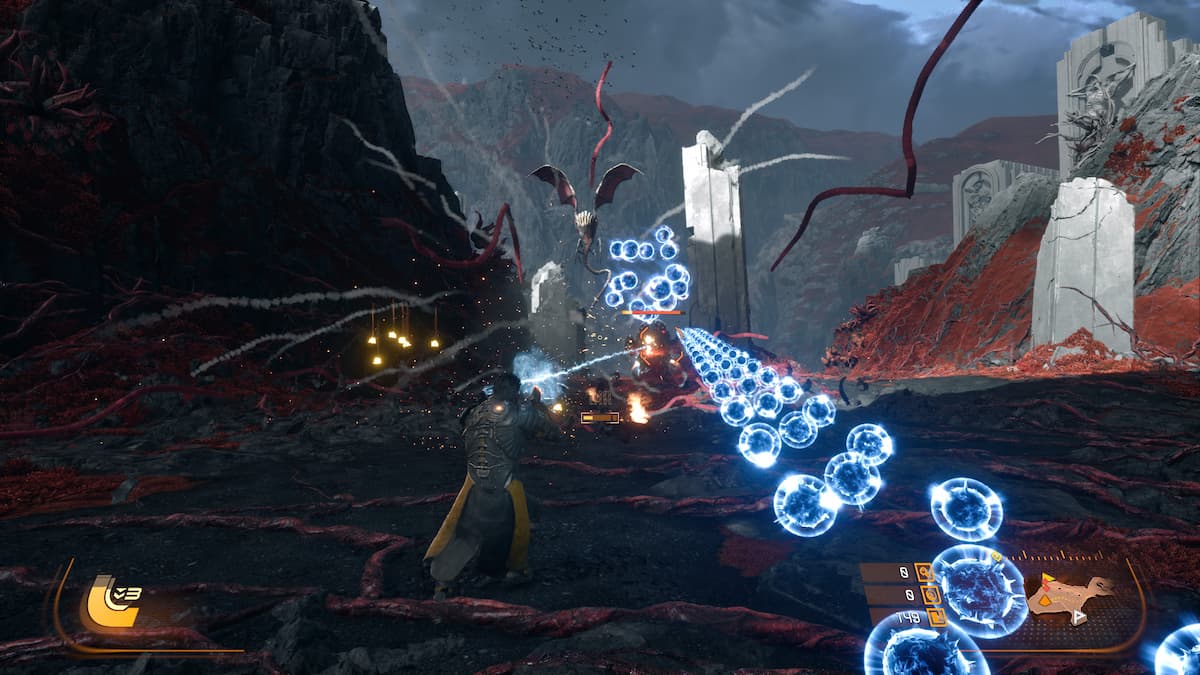
There’s a reason why Housemarque loves calling this game a bullet ballet rather than the traditional “bullet hell”. It’s all about finding a rhythm, and nowhere does the game’s thesis come through clearer than in its boss fights.
When I previewed the game, I died to the Prophet (the first boss) twice before finally taking it down. This time, however, after doing some hand and finger stretches (never mind the fact that I was also already armed with prior knowledge of the fight), I realized that the entire fight was essentially one big rhythm game. Three corrupted orb blasts. Dodge, dodge, dodge. Blue orb blast. Stand still and shield. Combination of both. Hold block, jump, jump, jump. The timing of the Prophet’s attacks lining up with the pulsating music helps too, and I soon realized this logic could be applied to all of Saros‘ boss fights.
It sounds pretty basic, I know, but it’s a critical mindset shift that allowed me to center and ground myself during these fights instead of running around like a headless chicken spamming dodge whenever something entered my peripheral vision.
It helps that Saros‘ bosses are also generally quite good at telegraphing their attacks and establishing patterns. While they’re still challenging, the patterns never change, which provides players with a much clearer path to learning the fight and eventually acing it. Critically, I think this is what sets Saros apart from something like Dark Souls. The patterns are set. They’re always going to go in a certain order. Learn the dance, or fail. I finally understood why Housemarque was so insistent on calling this a bullet ballet. All the times you die to a boss are just practice sessions for the actual performance.
Don’t get me wrong, though. This is still a game that will kick your ass if you get too complacent. About midway through each biome, you’re forced to trigger an Eclipse, which strengthens enemies and gives their attacks Corruption effects, and also introduces Corrupted Artifacts.
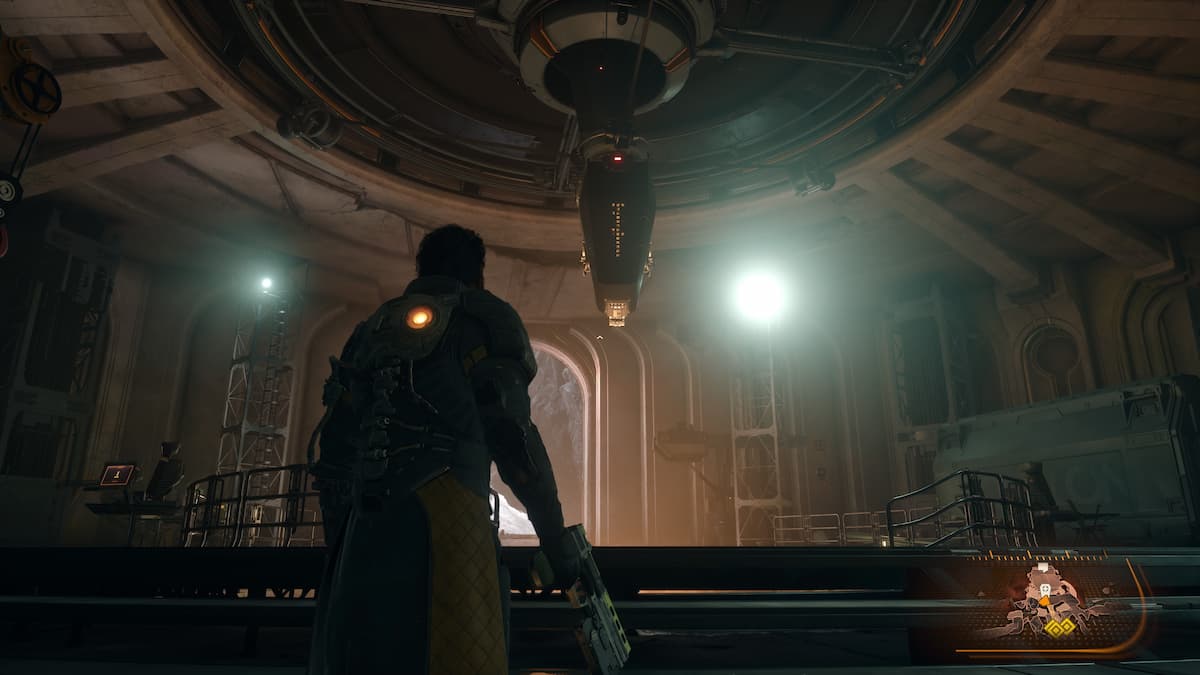
First off, Artifacts are perks you can pick up in each run. Pre-Eclipse, it’s all upside. They can increase the amount of Lucenite you pick up, or strengthen you in other ways. Post-Eclipse, however, there’s a tradeoff. A Corrupted Artifact might give you a really huge damage boost, but at the cost of increasing your dash cooldown. You absolutely don’t want that. Unless you wanna dance through this recital with your legs tied together.
Corrupted attacks are problematic, too. Getting hit by the yellow Corruption will reduce your maximum health, and you can only cleanse the effect by hitting enemies with your Power attack. Here’s the catch, though. In order to use your Power attack, you need to absorb those blue enemy orbs with your shield. And once you’re in the Eclipse, it’s all yellow, baby. There’s rarely any blue. It’s a brilliant, genius, yet also cruel catch-22 that forces you to decide if taking damage is worth charging up your Power attack for.
These decision-making processes get amplified in Saros‘ boss fights. It’s still a dance that you can learn, yes, but when something goes wrong, you’d best be ready to make a split-second decision.
As you progress further into the game, you’ll eventually unlock other permanent abilities that let you explore even more of the earlier biomes. These include a higher jump and the ability to break through gold-colored forcefields that were previously impenetrable. Saros highly encourages you to revisit previous biomes, and your exploration is often worth it.
There are permanent character upgrades to unlock between runs too, which make Saros much more approachable. These include more health, revives, shield capacity, and increased Lucenite gains. You can only upgrade Arjun up to a certain point before you’re forced to beat a boss in order to progress, but these upgrades certainly do make things way easier.
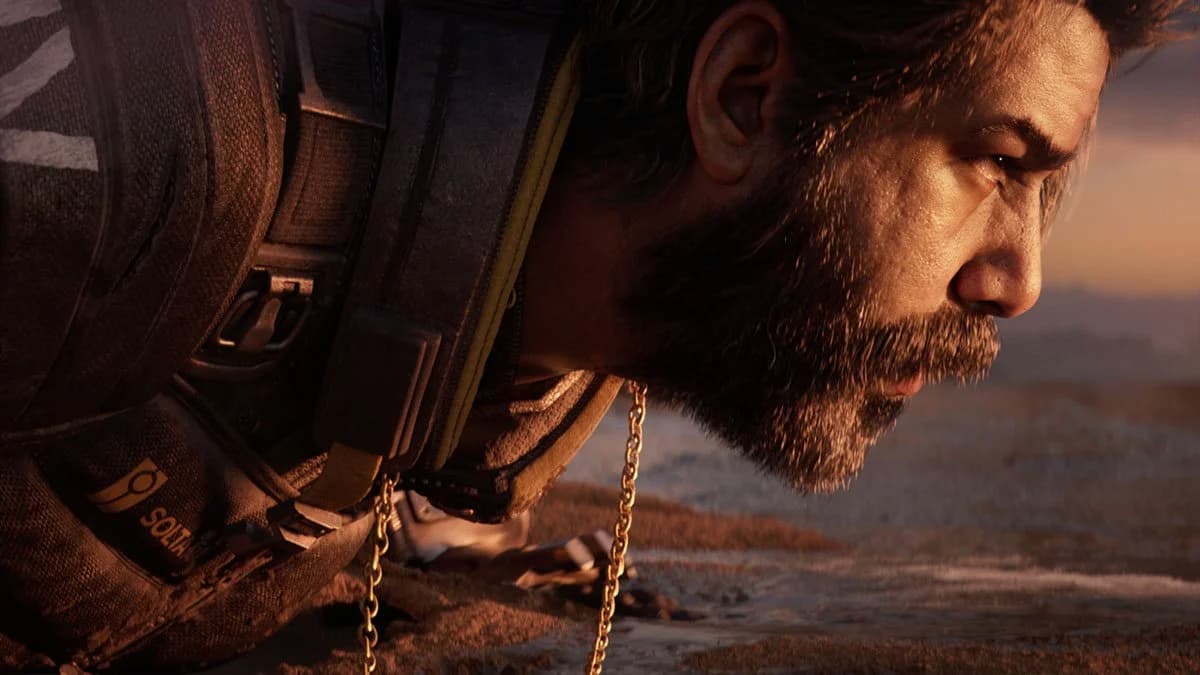
Tying all of these elements together is Saros‘ story and cast. You take control of Arjun, a Soltari Enforcer part of a crew that’s been sent to this strange alien planet to find out why the company’s lost contact with the previous team. It’s clear from the get-go that he has a personal stake in this, as we get flashes of a woman whom we assume to be his partner in between runs, and Arjun is absolutely desperate to get to her.
The performances are, of course, top-notch. Arjun is voiced by British actor Rahul Kohli (The Haunting of Bly Manor, iZombie), who delivers an impassioned performance that gripped me despite the fact that I felt no connection to his struggle whatsoever.
That’s Saros‘ shortfall, in my view. The story itself, while decent, largely takes a backseat to the moment-to-moment action. This issue is exacerbated by the fact that Arjun’s supporting cast is rather bland, save for his superior Sheridan, voiced by Jane Perry, who also voiced Returnal protagonist Selene Vassos. Perry, as usual, is excellent here as the cynical, rugged, older lady who’s all business and no nonsense. I rather enjoyed Arjun’s conflicts of interest with Sheridan, as the two are constantly torn between the former’s desire to look for his lover, and the latter’s focus on the mission, getting what they need, and then getting the hell out of there.
Unfortunately, the rest of the supporting cast fell flat for me, and even the story cutscenes often just felt like stopgaps getting in the way of me running and gunning and bullet ballet-ing. Unlike Returnal, which I would argue was more of a character study rather than a story-driven adventure, it seems Housemarque wanted to go in the opposite direction with Saros but ended up falling short on both fronts.
Stellar voice performances aren’t enough to carry largely one-note characters and story beats, which is a shame because the alien planet of Saros feels so terrifying and rich. The planet of Carcosa takes its cues from the cosmic horror genre, with Chambers’ The King in Yellow being an obvious source of inspiration. The enemies and level designs scream opulence, decadence, and the folly of seeking forbidden knowledge, creating an atmosphere so engaging and immersive I just want to spend all my time in it.
I’m a huge fan of the enemy and boss designs, as well as the level layouts which are often smart, recursive, and, once again, force you to make tough decisions as you ponder whether to go for more health or more power while the area gates close in front of you.
Saros lives up to its name of being a bullet ballet in every sense of the word. It’s a fast-paced, frenetic shooter adventure that never lets up from start to finish. While the story leaves a lot to be desired, learning the intricacies of each deathly dance with Saros‘ bosses is some of the most fun I’ve had in a video game in ages.
A review code for the game was provided by the publisher. You can check out our review policy here. Reviewed on PS5.


无话可说,只是看看
谢谢支持!