I’ll begin with a disclaimer. I’ve never played any of the Plague Tale games, though I’m certainly well aware of how well received those original games are. It’s a series that I’ve always had a vague interest in, but could never quite bring myself to commit to because its stealth mechanics always put me off. Resonance: A Plague Tale Legacy is a prequel that takes place before the first two games, and after being told that it’s less stealth-centric and an easy entry point for newcomers, I was finally ready to explore this world for myself.
The results are a little less exciting than I had anticipated. While Resonance: A Plague Tale Legacy clearly has a lot of heart as evidenced by its top-notch soundtrack, voice performances, and other design flourishes, it’s held back by a largely middling story and some design frustrations that I find I have increasingly less patience for in modern video games.
Resonance puts you in control of Sophia, a smuggler who you may be familiar with if you’ve played Requiem. Resonance serves as Sophia’s origin story, starting all the way at the beginning with her childhood, her self-discovery journey, and how she eventually becomes the Scorpion of the Sea that many have come to know and fear. I’ll say right off the bat that Sophia is a certified badass, and I do love me a bad bitch. See: 2B, Lightning, Korra, Chloe and Nadine, Ellie, the list goes on. So it didn’t take long for me to warm up to Sophia even without the context from A Plague Tale: Requiem.
I’d heard the world of Plague Tale was grim, but even that didn’t prepare me for its brutal opening sequence depicting Sophia in a convent where evil nuns run all sorts of brain experiments on her. Thankfully, that sequence is short-lived, as she’s quickly rescued by her smuggler/plunderer dad Alec, and so begins her journey to become a smuggler of the seas.
For the most part, I enjoyed Sophia as a scrappy fighter looking to work her way up the chain of command while learning more about her past and the lasting effects those convent days had on her. What I didn’t enjoy, however, was how cliched everything else around her felt. You’ve got the caring father, the father’s best friend who’s obviously sus as hell, the kindly uncle, and the combat master who’s harsh but fair. As I played through Resonance‘s opening hours, I couldn’t shake the feeling that I already knew how most of their character arcs were going to end. And sure enough, the first half of the game proved me right in almost every aspect.
It’s not until Resonance‘s final act that the story starts taking slightly bolder swings, some of which genuinely surprised me, but by then it felt like it was too little too late. It doesn’t help that the pathing and wayfinding could feel frustrating at times, even in what is generally a linear story-driven game.
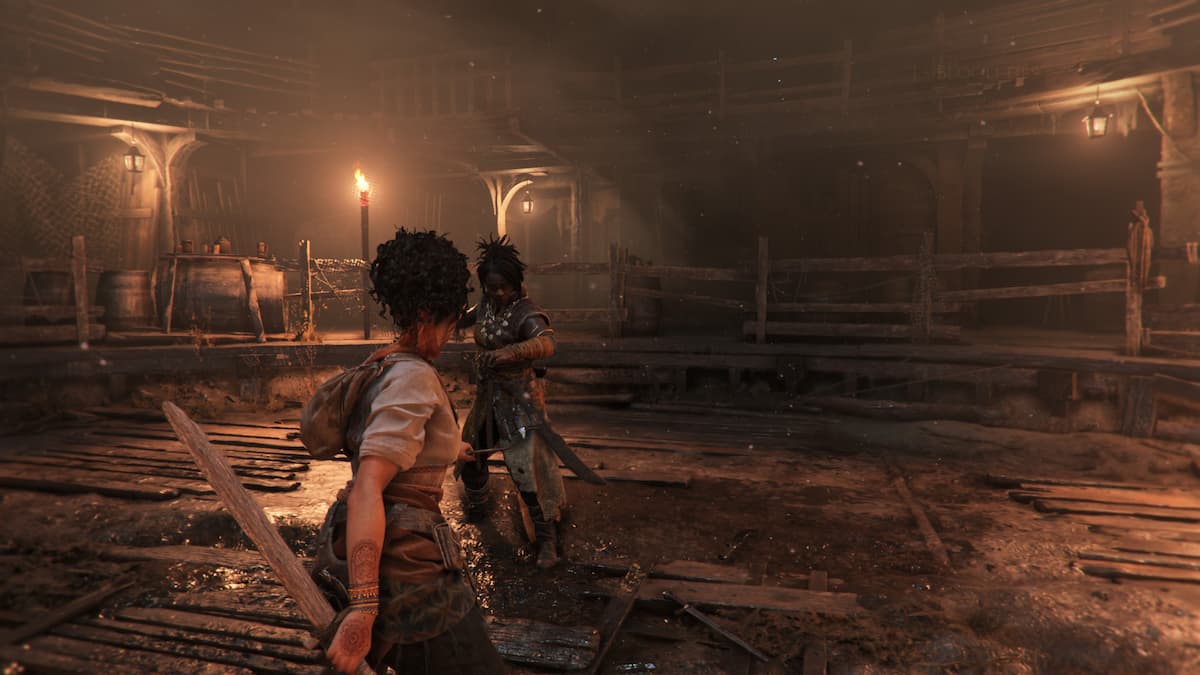
While the environments are all very detailed and beautiful, I found the wayfinding to be oddly unintuitive. Invisible walls or strategically placed NPCs would block your way in areas where it looks like you should be able to progress, yet you’d be able to get past them easily in other instances if you happen to chance upon the spot where the game wants you to go. What seemed like easy jumps would have me plummet to instant death because that wasn’t where I was supposed to go. These are things I’d normally just tolerate because video games will video game, but I did find that these cropped up way too many times for my liking throughout Resonance‘s around 25-hour runtime for me to ignore.
Thankfully, the combat is fun enough that I was able to forget about those instances until they came up again. Resonance: A Plague Tale Legacy features a combat system that’s basic enough to pick up, but still fun to actually play even if it’s not really doing anything new. You press a button to attack, and you press it multiple times to do a basic combo. Enemies can guard against you, but you can also break their guard by pressing a button to kick them. Then there are your usual parries, where you press L1 just before you get hit to deflect the attack. Most times, you’ll need to press it in succession to deflect an entire combo string, but if you pull it off, you can tire out your foe for just a few seconds — long enough to deal a killing blow.
Things start to get crazy once you unlock the grapnel, which is basically just a grappling hook for traversal. The fun thing is that you also get to use the grapnel to hook and pull enemies to you, or to their death if they’re on top of a building. I later discovered that I could also break an enemy’s guard with the grapnel pull, which just made me feel insanely powerful and basically unstoppable. Add on the fact that you recover health by taking down enemies, and you may quickly find that Resonance‘s combat tends to skew a bit towards the easy side, even on normal difficulty.
Even so, that didn’t stop me from enjoying the combat, especially as I started unlocking more abilities on the skill tree. As you progress, you gain Resonance Points, which can be used to strengthen Sophia in all sorts of ways, such as making her staggers more powerful. In any other game, I might’ve criticized Resonance: A Plague Tale Legacy for being a little too easy, but in this case, I appreciated the ease with which I could get through combat, especially since I didn’t particularly enjoy the exploration aspects and was more interested in seeing the story.

I will say that Asobo Studio did do a good job of endearing me to Sophia though, particularly in her interactions with Leni, another bad bitch who specializes in lockpicking and plays off of Sophia extremely well. Leni’s character arc also became increasingly predictable the more I played, but that wasn’t quite enough to stop me from enjoying the banter between her and Sophia. I can’t overstate just how much I enjoyed Sophia as a character, powerfully voiced by Anna Demetriou, who lends such passion and ferocity to the character.
I’ll admit that I do have a soft spot for the impulsive, spunky female leads so, again, Resonance didn’t really need to do much to get me onboard here but still, credit where it’s due.
Resonance: A Plague Tale Legacy is a fair effort at onboarding newcomers and introducing them to the world of Plague Tale. As much as I enjoyed Sophia and Leni, however, its shortcomings in the design department left a lot to be desired, and I’m left wondering if I would’ve been better served starting my journey with Innocence after all.
A review code for the game was provided by the publisher. You can check out our review policy here. Reviewed on PC.