It’s crazy to think that it’s been 10 years since the original release of Overwatch. In those 10 years, I’ve changed a lot. I don’t enjoy playing video games on my PlayStation as much any more. I’m nore of a PC and Switch girlie now. I no longer tune in to every Overwatch League match, fervently praying for the Shanghai Dragons to finally get their first win. I no longer get mad when online strangers tell me over voice chat that I’m bad at Overwatch Competitive. And I certainly don’t hop on voice chat to snap back at them and yell expletives. I’ve grown up.
Overwatch has changed over the last 10 years, too. What once seemed like a sure evergreen thing for Blizzard quickly devolved into a toxic competitive cesspool, as most shooter games are wont to do, but things only got worse when Overwatch 2 launched with none of the PvE goodness we were promised. It didn’t take long for me to drop the game entirely. With Blizzard’s big Overwatch rebrand (we’re dropping the 2!) and a refocus on world-building and PvE, however, the game has my interest again. After spending an entire day reacquainting myself with Overwatch and its new heroes, I’m finding myself hooked again like it’s 2016. Surprisingly, it’s not the new animated short that’s got me excited; instead, it’s the new support heroes I’ve been missing out on all these years, and how incredibly fun they are to play.
With Overwatch Season 1, Blizzard has released five new heroes to the roster. Vendetta is the clearly the main star, as she’s prominently featured in The Reign of Talon animated short, and so too is Anran, another new damage dealer. The one that really caught my eye, though, is none other than Jetpack Cat who, as the name suggests, is a cat on a jetpack.
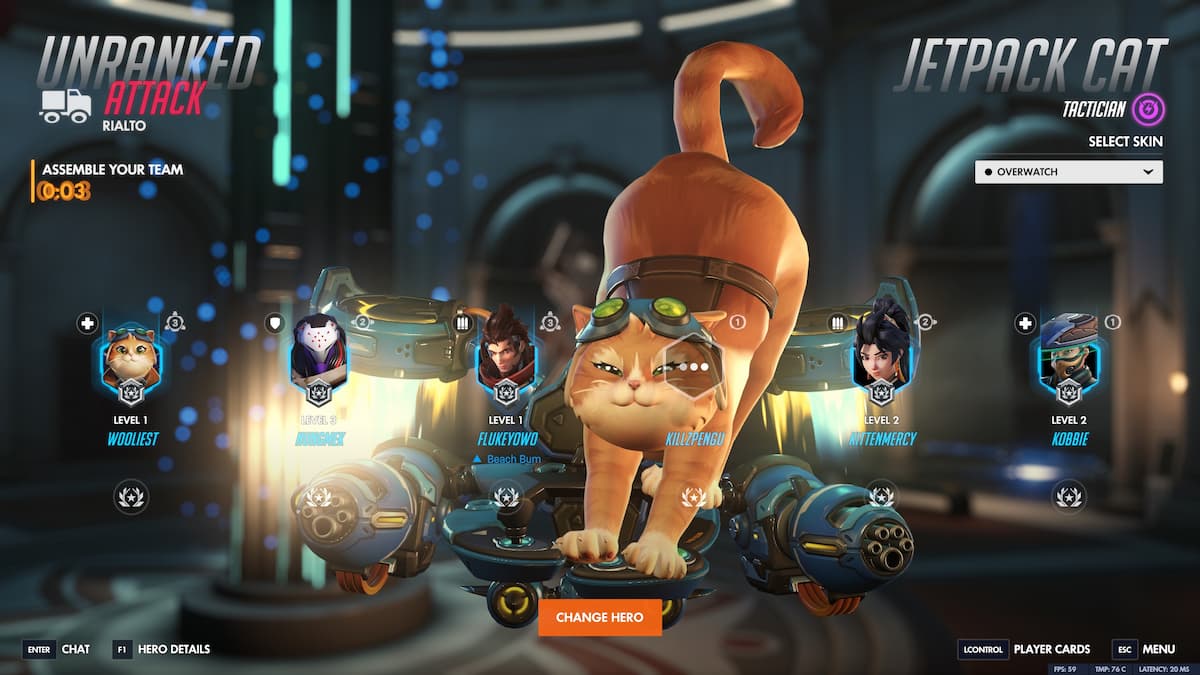
Genius design and naming aside, Jetpack Cat isn’t just an adorable character, she also happens to be an incredibly fun support hero to play. Back in my day, the only support heroes worth a damn were Zenyatta, Ana, and Lucio, and maybe Mercy once her Ultimate got reworked. Fun as these characters were, the fact remains that the support roster was too limited. And as someone who really loved playing support and tank (because I can’t aim to save my life), I’d always felt envious of the DPS mains who seemed to have so many characters to choose from. Not to mention the fact that aside from Zenyatta and Ana, the support characters always felt kinda helpless because their success would often rely on the rest of the team. The ‘carry’ heroes were always the tanks or damage dealers, as is often the case in games like these, which meant that being a support main could feel downright depressing at times.
Over the course of my first day back in Overwatch, however, I played with Jetpack Cat. I played with Juno. I played with Mizuki. And the thing that stuck out to me the most was just how impactful these support heroes could be in any given match.
As Overwatch has evolved, so too has the hero design. New support heroes need to bring something new to the table, and these guys bring them in spades. Jetpack Cat has the ability to carry teammates around on a rope and fly them around the map, unlocking flanking possibilities I couldn’t even have fathomed before. Juno specializes in buffing up her teammates by throwing down a ring that speeds up her allies when they pass through it. She’s kind of like a souped up Lucio, with the ability to heal and buff at the same time. Finally, Mizuki was clearly created for all the weebs out there as he might be one of the coolest support heroes Overwatch has ever seen. Mizuki’s trick is that he can hinder enemies by throwing his hook at them. He feels more like Zenyatta in that he’s more focused on damaging foes rather than healing, though his healing capabilities are pretty nifty too, as he throws his healing hat at an ally and it bounces off of nearby teammates, healing them too.
All three of these support heroes felt impactful in every match I played, and that’s exactly the kind of feeling I had always found myself chasing back when I was obsessed with Overwatch in 2016. Sure, there were times where a well-timed Resurrection or Sound Barrier could turn the tide in a fight, but I never actually felt like a playmaker. With these new support heroes, however, I found that their Ultimates were often able to signal the start of a really good push towards the objective, and I felt like I was finally in the driver’s seat, leading the charge.
Before I knew it, hours had just melted away as I queued up for match after match in Overwatch. Man, it’s 2026, Overwatch is so back, and that feels good to say.