A few months ago, I worked on a story about the psychology behind sad music. As a food and lifestyle writer, it was well outside my niche, but getting the opportunity to collaborate with psychologists, musicians, and composers to understand how our brains respond to music made it especially rewarding.
These conversations outside of your usual beat are what provide depth to any story, and it’s also why cross-disciplinary collaborations tend to resonate so strongly. It’s what makes Vampire Therapist such a remarkable effort, a game that was essentially borne out of professional cross-collaboration. The 2024 PC game from Little Bat Games not only turns cognitive behavioral therapy, historical figures, and immortal ennui into a deeply moving piece of edutainment, but also wears its partnership between game developers and licensed therapists on its sleeve with pride.
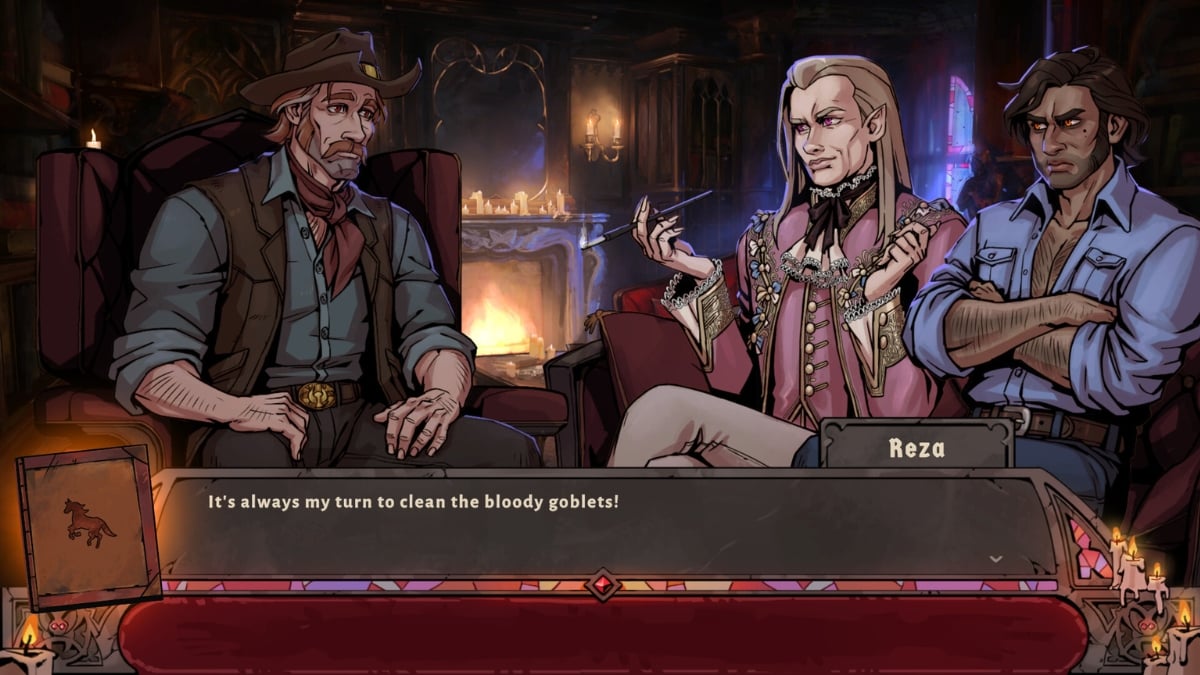
In Vampire Therapist, you play as Sam Walls, a 200-year-old vampire who decides to, well, become a therapist for other vampires. You may know Little Bat Games founder and director Cyrus Nemati as a voice actor, most notably for his role as Dionysus in Hades II. His writing career began almost accidentally, through opportunities to punch up dialogue and reshape material into something more readable. Over time, he found that writing for games scratched the same itch as voice acting: both required empathy and a sense of how people sound when they are trying — and failing — to be understood.
“For me, writing is a very similar sort of muscle to voice acting where it’s about empathy,” Nemati says. “I have to know what the character is feeling, so I come to it from a very narrative basis. The games that we produce are always going to be much more narratively driven, so it’s something that I can do.”
Little Bat Games itself emerged when Nemati decided to take the leap and start his own company with German state funding. The result is a small independent team with a clear identity: historically themed indie games that start with a strong premise and build outward from there. For Vampire Therapist, that premise came about after watching Twilight. When Edward plays the piano for Bella for the first time, we probably expect him to play a classical masterpiece, and Nemati poses the question: why? Why did we expect Edward to be effortlessly impressive? What if immortality did not automatically equate to mastery? What if a centuries-old creature still had emotional messes to work through?
Those questions became the backbone of Vampire Therapist. Vampires were a natural fit as immortality makes them the perfect vessels for exploring emotional stagnation, trauma, and change. As a history buff himself, Nemati also wanted a framework that could connect the game’s characters to history in a meaningful way. He started with a punchline, and then worked backward to find a historical figure to support it. In one case, that meant building a character around a hatred for Star Wars: The Rise of Skywalker and landing on Renaissance patron Isabella d’Este.
“So when I was initially conceptualizing the game, I wanted to have a vampire that had particular beef with Star Wars Episode Nine: The Rise of Skywalker because I hated that movie,” he laughs. “I hate it in a very complex way — it’s not because it’s bad, it’s because it’s nothing. And the nothingness was the thing that I wanted to explore.”
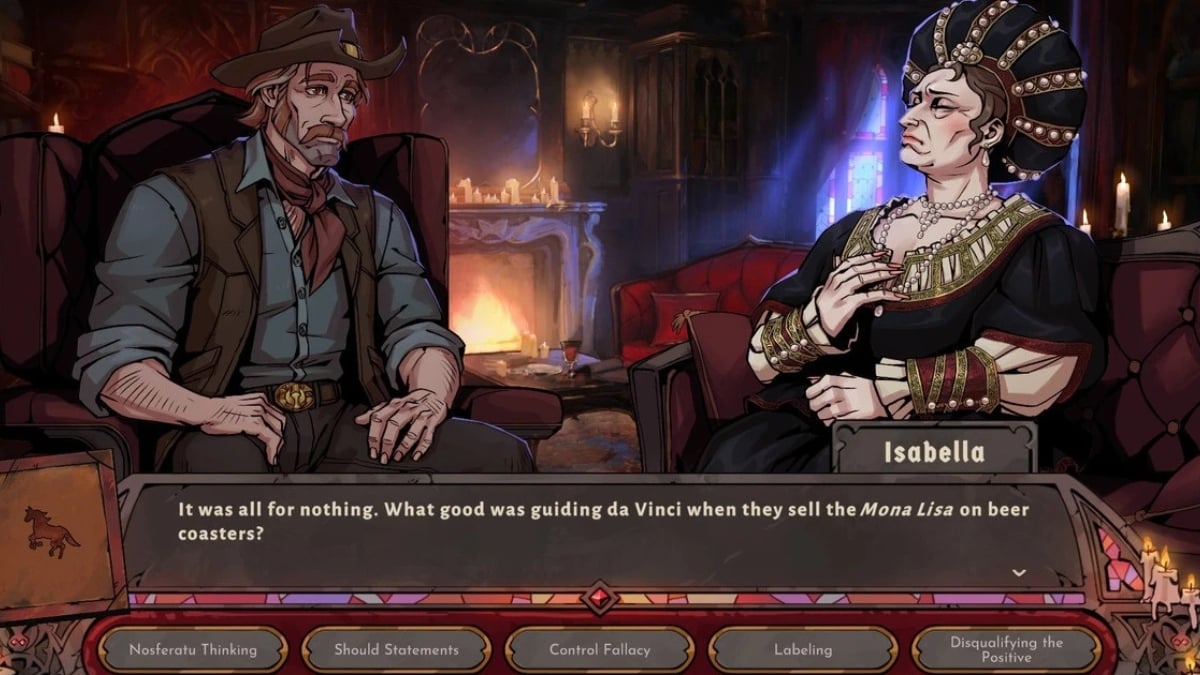
Nemati also did extensive research to make sure the game’s inspirations felt grounded, even when it took creative liberties.
“There was a historian in California who translated 20,000 of Isabella d’Este’s letters, so I bought it,” he says. “I had to install this academic DRM to get it and I read all of them to get a better sense of her personality, so what you read in the game is how she reads in real life.”
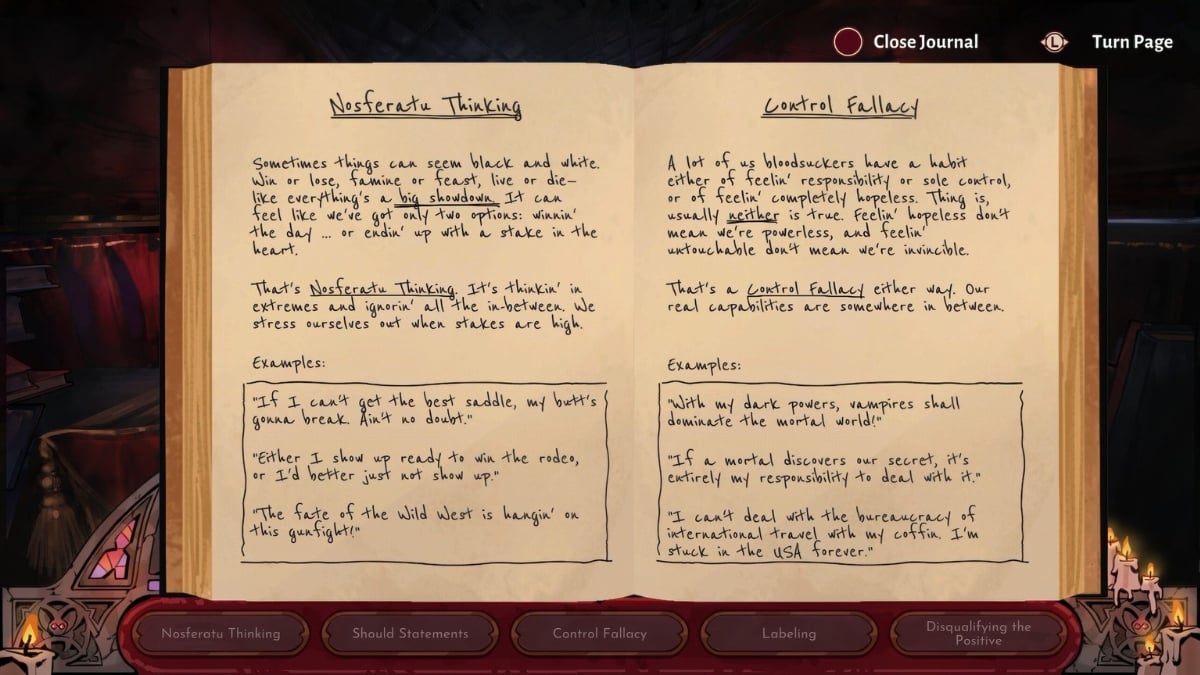
Vampire Therapist’s most important collaboration, however, was with licensed therapists. Nemati says the partnership was essential in creating Sam’s journal, which explains cognitive distortions and gives players examples to identify during each scene. He notes that creating the journal was one of the biggest challenges — not because the material was impossible to understand, but because it had to be clear, precise and non-ambiguous for the player.
“The therapists actually went through the entire script and we had a lot of back and forth on whether the distortions made sense,” Nemati says. “I didn’t want it to be a case where every single statement could have all the distortions applied to it, so it was very difficult writing to make sure the distortions weren’t ambiguous.”
This emphasis on collaboration has become one of Nemati’s priorities when developing games. For Little Bat Games’ upcoming release, Better Than Us, Nemati has worked extensively with historians and theologians from Oxford University, UC Davis, and the University of Florida, to gain a better understanding of what happens when a few people hoard most of the world’s wealth.
While collaboration with industry experts has become a core part of Little Bat Games, Nemati admits that this wasn’t the case at first.
“I saw what working with professionals added to Vampire Therapist, and I saw that they’re very eager to contribute,” he explains. “Academia is not in a good state right now, and the humanities are suffering in particular. So for me, not only does it make the game better, but it’s also an opportunity to bolster particular modes of thinking that I think are being left behind.”
Nemati also notes that there’s been a gap in the gaming industry to involve outside expertise in recent years, which he hopes Little Bat Games can help fill. While historical focus will always be the core of the team, Nemati also hopes to invite players to do a little introspection when playing his games.
“Marc Andreessen recently said that he has a zero introspection mindset and that the idea itself is a modern invention,” Nemati says. “So if this is the ethos of our time, then I need to do a little work against that.”


👍