I’m on turn 3. If I can wipe out five more demons this round, I’ll be golden. If I fail, well, there’s always another turn. But that won’t do because I’m not just looking to win the battle. I’m looking for that perfect grade, and I’m going to keep restarting the battle until I get what I want. Demonschool is a tactical RPG from Necrosoft Games that strips away the fat and the big numbers that so many other RPGs tend to get wrapped up in, and instead focuses on the essentials. The result is an incredibly compelling RPG with tight mechanics that reward strategy and excellence.
Let me back up a bit, though.
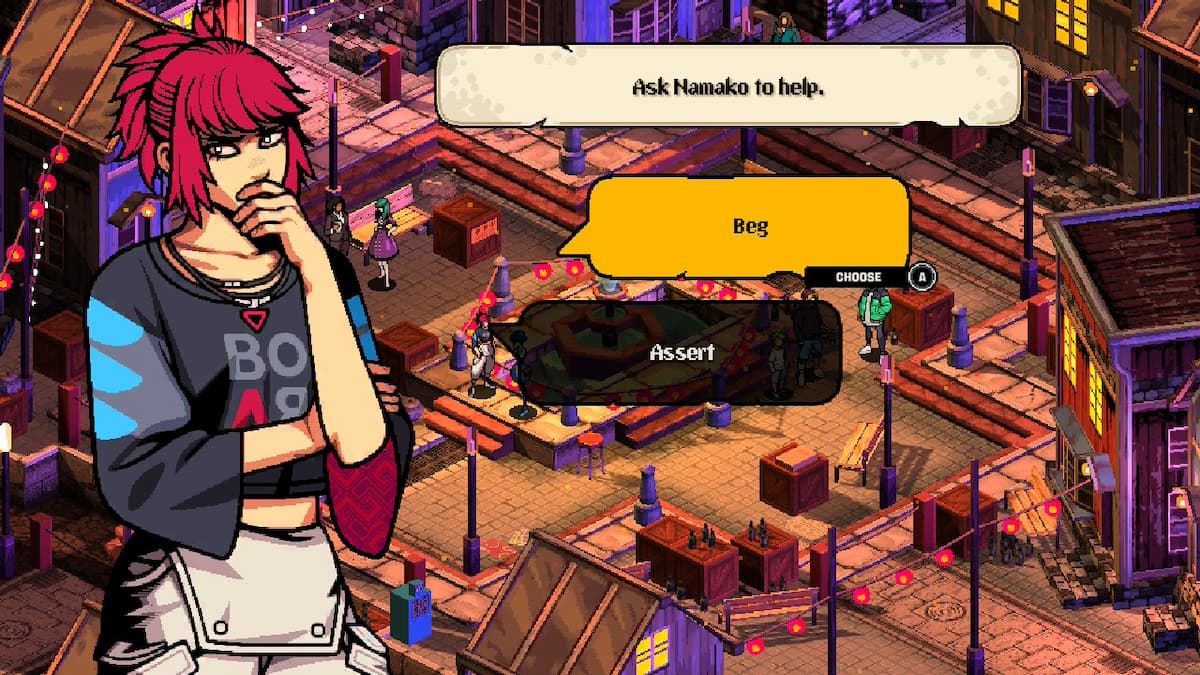
Demonschool opens with you taking control of our protagonist Faye, a self-proclaimed demon hunter from a long lineage of demon hunters. Despite demons being, well, folklore and hearsay, Faye is convinced that the school she’s en route to is awash with demons and it’s her job to take them down. Faye is brash and loudmouthed, and somehow she manages to persuade the meek, introverted Namako to follow her, despite Namako’s wishes to just stay in her lane and away from the drama.
Elsewhere, a professor is putting his college students to the test by telling them that they have to investigate a haunted wing of the school. Things may go awry, he says, or they may not. Within seconds, the students are assaulted by invisible monsters and they tragically melt into small piles of goop. The professor shrugs, makes a note on his clipboard, then goes about his day.
Demonschool is wonderfully irreverent. The dialogue is quick and quippy, indicating that you’re never meant to take the plot too seriously, and it keeps things moving along at a nice clip. You’ll pick your destinations from a map, and move Faye around the different areas from a top-down, isometric perspective. Your next destination is always conveniently indicated from the list, which helps to move the plot along quickly, but at the same time, it does take away from the mystery factor of Demonschool.
After all, Faye and crew are here to solve the demonic mysteries of the island — a task that can only be accomplished by the Scooby Doo gang squad we’ve got here. Faye is the brash one, Namako is the tired one who’s so over everything, Destin’s the knuckle-headed bruiser, while Knute serves as the ever reliable healer. The chemistry between the main cast is instantly electrifying, and thanks to the easy and quick-paced dialogue, time is rarely ever wasted on boring exposition, allowing the characters to quickly click with each other.
Battles are played out in turn-based affairs on a grid map. Each turn, you’re given a set number of action points (AP), which can be used to move your characters and take actions. There’s a catch, though; the more you use a character in a given turn, the more AP it’ll cost. For instance, it’ll cost one AP to move Faye for the first time and take an action, but it’ll cost two AP the next time you use her, and so on and so forth. AP management becomes a crucial part of combat, as you really want to make sure you’re being as efficient as possible with how you’re using each character.
Every character comes with unique quirks, too. Faye is an all-around damage dealer, while Namako doesn’t deal any damage at all and instead debuffs enemies and weakens them, making it so that you can take them out in one hit. You can move in straight lines or diagonally, or sidestep left and right before taking aim. You can also punch enemies into your allies to trigger special moves, wiping out a whole group in one fell swoop. After you’ve exhausted all your AP, you end your turn and watch all your carefully planned moves play out in real time. It’s very satisfying, and easily my favorite thing about Demonschool.
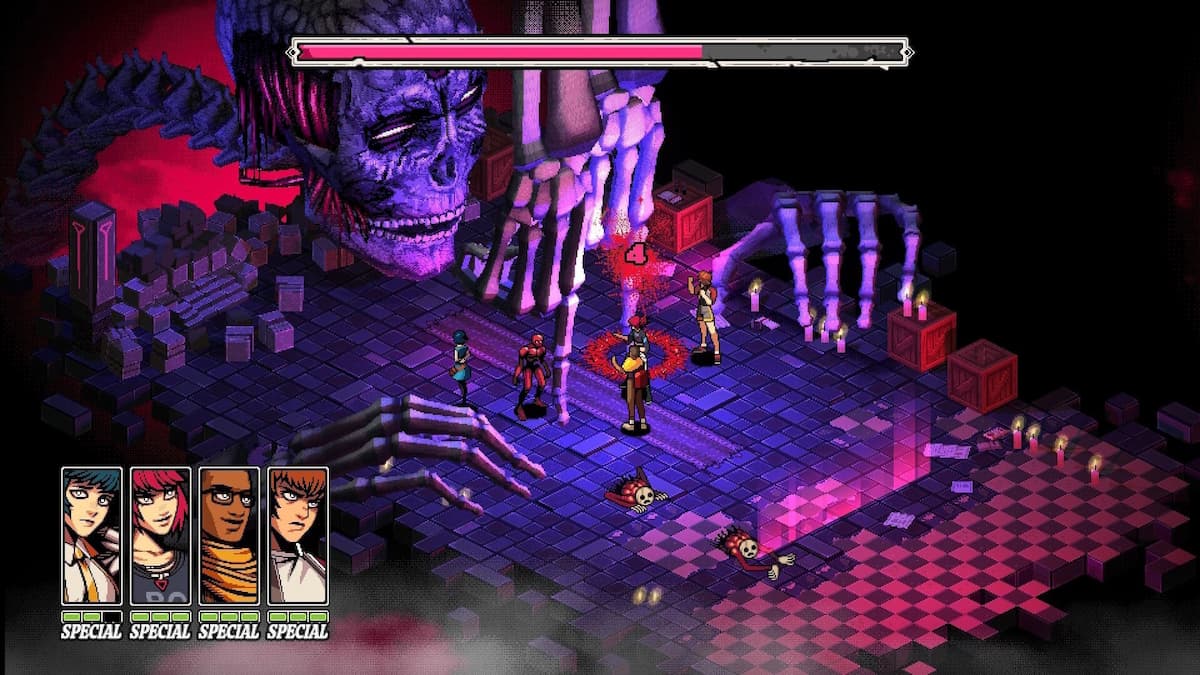
Battles in Demonschool aren’t necessarily difficult, especially since it’s so easy to rewind and redo your turns, but you do have to be careful with positioning. Every character starts off with around 3 HP, and by keeping the numbers small, every action you take feels extremely impactful. Demonschool makes things more interesting by introducing special conditions you need to meet in battle in order to get a perfect score. Mostly, you’ll need to clear the battle within a certain number of turns, which is always much harder than it might first appear to be. Top marks aren’t necessary for progression, and even as someone who doesn’t typically go for optional challenges, I found myself restarting battles more often than not because the combat was just that much fun to tinker around with and I wanted to see how far I could push myself.
While the story itself is simple enough, the characters and writing more than make up for it. Though I suppose if almost everything is played off as a joke or a quip, then it becomes hard to take anything too seriously. That being said, I was pleasantly surprised by how eerie the game could be despite the quirky characters and dialogue. There’s the ever cheery father who talks about how much he loves all his kids, who all slowly disappear one by one as the days pass. There’s the cemetery with the dog you can pet, and you just know something strange is going on down there. The few times when Demonschool properly leans into its pulpy horror side, the game truly shines.
I should note that Demonschool was plagued by quite a few bugs during the review period, though I believe most of them have been resolved at this point via a patch, which is why I wanted to wait before putting out my review. Prior to the patch, there were several issues like certain mini-games being non-repeatable, and ending routes being completely borked. Thankfully, I didn’t encounter anything particularly game-breaking during my full playthrough, though it was a bit of a bummer that I couldn’t fully enjoy the mini-games along the way.
Demonschool is one of the most innovative tactical RPGs I’ve played this year. While I fully acknowledge that its irreverent tone may not be for everyone, it’s still an easy recommendation for RPG fans, especially those looking for a more in-depth strategic experience that truly tests your ability to visualize your moves before they happen.
A review code for the game was provided by the publisher. You can check out our review policy here. Reviewed on Switch 2.